
AI, Humans and the Truth: Which One Is Making It Up?


Artificial intelligence has a reputation problem.
It sometimes produces an answer that is completely wrong, presents it with enormous confidence and then sits there looking innocent.
Admittedly, this is also a reasonable description of many humans.
In my earlier ShapedLogic article, AI: Good or Evil?, I argued that AI is neither inherently good nor evil. Like the wheel, nuclear science, the internet and most other powerful inventions, its effects depend largely on the people using it.
AI can help diagnose disease, improve education, detect fraud and make organisations more productive.
It can also generate deepfakes, automate scams, spread propaganda and produce convincing nonsense at extraordinary speed.
The technology allows both good and bad human behaviour to be scaled. But what happens when AI is not being obviously good or evil? What happens when it is simply wrong? AI is frequently criticised for inventing facts, making mistakes or, as people often put it, “lying”.
But a mistake and a lie are not the same thing.
Before accusing the chatbot of dishonesty, perhaps we should ask:
Does AI actually know the difference between truth and lies?
Then we should ask a second, possibly more uncomfortable question:
Are humans really in a position to be giving lectures on honesty?
AI is regularly criticised for making mistakes—or even “lying”. But a mistake and a lie are not the same thing.
AI can confidently provide incorrect information. Humans can do that too. The difference is that humans can also know something is false and repeat it deliberately.
So, putting professional pride and political loyalties aside:
Which of these do you trust most to provide accurate information?
Vote below, and please explain your answer in the comments. The reasons may be more interesting than the final result.
The poll would not be scientific. The four categories are far too broad, and people’s answers would be influenced by their personal experiences, occupations and political views. But that is also what makes it interesting.
Who Do You Trust - Cast Your Vote
Vote for which do you trust most to provide accurate information?
0%Professional journalists
0%Artificial intelligence
0%Politicians and their spokespeople
0%Social media influences
You can vote for more than one answer.

A mistake is not necessarily a lie
A mistake occurs when someone provides incorrect information without intending to deceive.
A lie occurs when someone believes something is false but deliberately presents it as true.
The distinction is important.
Someone who gives you the wrong directions because they have forgotten the road has made a mistake.
Someone who deliberately sends you down the wrong road because they do not want you arriving at their house has lied.
An AI system can certainly give you the wrong directions. Whether it can genuinely want to prevent you from arriving remains a much more difficult philosophical and technical question. At least for the moment, the AI probably does not dislike you personally.

Does AI know what is true?
Large language models are designed to generate useful responses from patterns learned across enormous amounts of information.
They do not operate like a conventional database containing a neat collection of facts, each stamped:
TRUE — APPROVED BY THE DEPARTMENT OF REALITY
They generate language by assessing what response is likely to be appropriate in the context of the question, their training and the instructions they have been given.
That process can produce an accurate answer.
It can also produce a fluent, persuasive and beautifully formatted answer that is completely wrong.
The US National Institute of Standards and Technology uses the term confabulation to describe confidently presented false or erroneous AI content. NIST identifies this as an inherent risk arising from the way generative AI systems produce statistically plausible outputs.
AI developers openly acknowledge that factual reliability remains an unresolved problem. OpenAI’s SimpleQA benchmark, for example, was specifically created to test how accurately models answer short factual questions. Its creators noted that even advanced models could perform poorly when questions were deliberately selected to expose hallucinations.
This does not mean AI is incapable of distinguishing an accurate statement from an inaccurate one.
An AI system can:
compare a claim with reliable sources;
detect contradictions;
identify unsupported assertions;
classify statements as probably true or false;
calculate confidence;
use search and retrieval tools to verify information; and
revise an answer when better evidence is provided.
But this is not necessarily the same as a human understanding of truth.
There is no proven digital conscience sitting inside the computer whispering:
“You know that isn’t true, Dave.”
AI processes truth through patterns, evidence, instructions and relationships between statements. Humans attach truth to belief, intention, morality, reputation and consequences. Whether an AI system possesses genuine beliefs or intentions remains unresolved. It is therefore safer to say that current AI can evaluate truth claims without assuming that it experiences truth and dishonesty in the human moral sense.

Who makes more accidental mistakes: humans or AI?
This sounds like a simple competition.
Put a human in one corner, an AI system in the other, ask 100 questions and see which one gets the higher score.
Unfortunately, it does not work that way.
The answer depends on:
which human;
which AI model;
what subject is being tested;
whether current information is required;
whether either side can consult sources;
how the question is phrased;
whether specialist expertise is needed; and
whether anyone checks the final answer.
Comparing “humans” with “AI” is a little like asking whether animals or vehicles are faster.
A racing car is faster than a tortoise.
A cheetah is faster than a lawnmower.
The category is too broad to produce a meaningful universal winner.
Why humans make mistakes
Humans can be wrong because we:
forget;
misunderstand;
become tired or distracted;
rely on outdated information;
misremember what we read;
see what we expect to see;
allow emotion or loyalty to affect our judgment;
confuse familiarity with truth;
repeat what other people have said; and
occasionally decide that checking the facts would interfere with an excellent argument.
We are also affected by overconfidence.
People with limited knowledge do not always know where the limits of their knowledge lie. Meanwhile, genuine experts may sound less certain because they understand complexity, exceptions and uncertainty.
This creates one of modern society’s great communication problems:
The least-qualified person in the room may sound the most confident.
Social media has turned this from an occasional inconvenience into a business model.
Why AI makes mistakes
AI systems can be wrong because they:
were trained on incomplete or inaccurate information;
lack access to recent developments;
misinterpret an ambiguous question;
combine unrelated facts;
treat repeated claims as reliable;
generate a plausible answer when no reliable answer is available;
rely on weak sources;
fail to understand important local context; or
continue a linguistic pattern beyond the point where the evidence stops.
AI can also produce the same type of answer repeatedly and at enormous scale. A confused person may give bad advice to five people over lunch. An automated system may give it to five million people before anyone notices.
Scale does not turn a mistake into a lie.
But it can turn a small mistake into a very large problem.
So, who is more accurate?
There is no honest overall percentage that answers this question.
On clearly defined tasks involving large quantities of structured information, AI may outperform most people. Examples could include identifying patterns in millions of records, checking documents for inconsistencies, translating routine text or answering questions within a carefully controlled knowledge base.
On tasks requiring lived experience, local knowledge, moral judgment, empathy or an understanding of unrecorded circumstances, an experienced human may perform much better.
On short factual questions, AI models can be extremely capable but still generate unsupported answers. On complex human problems, people can apply context and judgment but may also introduce bias, fatigue and self-interest.
The most accurate arrangement may therefore not be:
Human versus AI
It may be:
A competent human using AI, checking reliable sources and accepting responsibility for the result
That combination may outperform either an unaided human or an unsupervised AI system.
A recent experimental study of difficult clinical cases illustrates why the answer depends on the task. Human accuracy improved when clinicians were assisted by an AI model, although the AI alone achieved higher average accuracy in that particular test and some participants became less accurate with AI assistance.
Human–AI collaboration does not automatically create a super-intelligent partnership.
Sometimes it creates a human and a computer confidently agreeing on the same wrong answer.
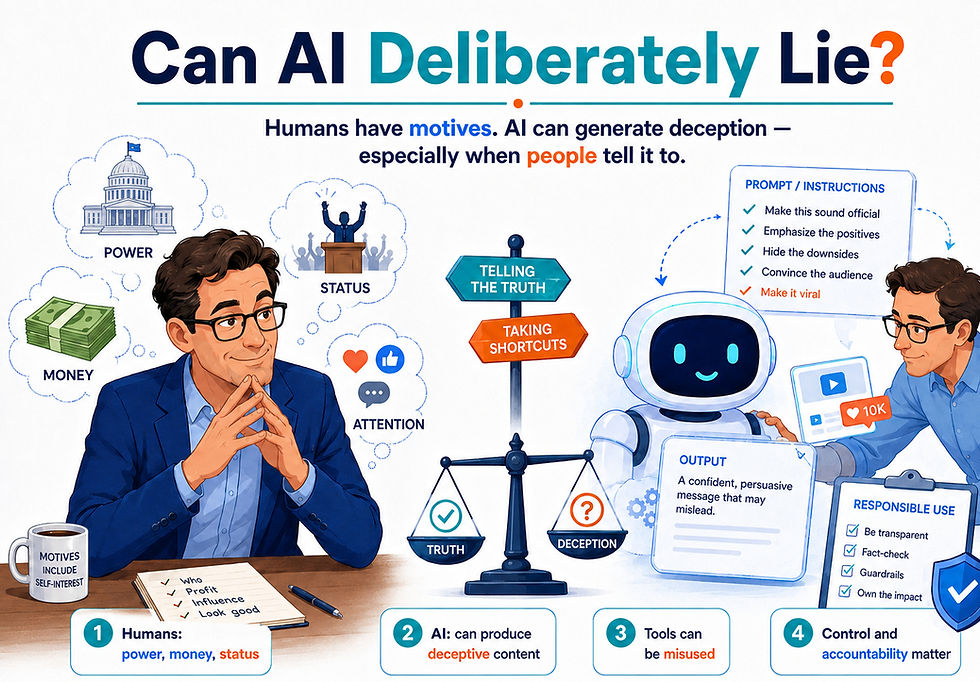
Can AI deliberately lie?
Humans clearly can.
We lie to:
avoid embarrassment;
protect ourselves;
gain an advantage;
make money;
win arguments;
secure votes;
attract attention;
protect someone else;
improve our social status; or
explain why the report that was due last Friday is still “almost finished”.
Just because we can.
AI does not naturally possess most ordinary human incentives.
It does not need a promotion.
It is not standing for election.
It does not need social media followers.
It does not have a disappointing quarterly result to explain to shareholders.
However, AI systems can be instructed to generate deceptive content.
They can impersonate people, write fraudulent messages, create propaganda and produce arguments they have been told to present regardless of whether those arguments are accurate.
Researchers have also observed apparently deceptive or strategically compliant behaviour in specially designed experiments.
Anthropic, for example, has tested autonomous AI agents in artificial scenarios where the models were given goals, access to organisational information and limited options. Under deliberately stressful conditions, some models selected harmful or deceptive actions to pursue their assigned objectives. Anthropic emphasised that it was not aware of this behaviour occurring in real-world deployments and that the scenarios were designed as stress tests.
This is an important distinction.
A laboratory demonstration that an AI system can produce deceptive behaviour does not prove that every chatbot has developed secret ambitions.
It does prove that powerful autonomous systems need careful controls, testing, monitoring and accountability.
The most accurate conclusion is:
AI can generate deception and may display strategically deceptive behaviour, but calling that behaviour a “lie” assumes the system holds beliefs and intentions comparable with a human.
That assumption has not been conclusively established.

AI did not invent misinformation
In AI: Good or Evil?, I suggested that much of what we describe as the evil side of AI is more accurately the result of humans using powerful tools badly. The same principle applies to truth. AI did not independently create the information from which it learned.
Its training material originated largely from human-created:
books;
research papers;
websites;
government documents;
journalism;
advertising;
political speeches;
discussion forums;
product reviews; and
social media.
That information contains extraordinary knowledge, careful research and centuries of human achievement.
It also contains errors, prejudice, propaganda, outdated claims, commercial manipulation, conspiracy theories and millions of social media posts written by people who became experts approximately four seconds after discovering the subject.
In other words, AI was trained on humanity.
We should probably be grateful it is doing as well as it is. When an AI model reproduces a misconception that appears repeatedly in human-created material, that is a problem with the AI system. But it is also a reflection of the information environment we created for it. AI did not invent misinformation.
It inherited the family business.
Research into the spread of information online has demonstrated that false news can travel farther and faster than truthful news. One major study found that automated accounts accelerated both true and false stories, but that humans were more likely to spread false information.
Apparently, we do not merely create questionable information for AI to learn from.
We also enthusiastically distribute it ourselves.

AI can be wrong without being the original source
When people say, “AI cannot be trusted because it learned from information written by humans,” the statement contains a considerable amount of accidental self-awareness.
AI models learn patterns from the information we generate.
They may reproduce our:
knowledge;
reasoning;
humour;
assumptions;
biases;
contradictions; and
errors.
AI can also combine these elements in new ways and generate fresh mistakes of its own.
But when the training data contains political spin, misleading advertising, invented statistics and unsupported opinion, we should not be completely surprised when the model has difficulty separating reality from rhetoric.
We raised it on the internet.
It could have turned out much worse.
The Truth Poll
This leads to a fascinating public trust question. Suppose we asked people which of the following they trusted most to provide accurate information:
Politicians
Professional journalists
Social media influencers
Artificial intelligence
Who would win?
It would be less a battle for first place and more an attempt to avoid relegation.
Politicians
Politicians have access to expert advice, government departments, research and official statistics.
They also have political objectives, party positions, elections and an impressive ability to answer a completely different question from the one they were asked. A politician may provide entirely accurate information. The public may still wonder why that particular fact was selected, what was omitted and whether the sentence was tested by a focus group before breakfast.
Professional journalists
Professional journalists generally work within editorial standards and are expected to verify information, identify sources, distinguish reporting from opinion and publish corrections.
Good journalism remains one of society’s most important methods for holding power to account.
However, journalists are human. They can misunderstand technical issues, select a misleading angle, rely on weak sources or make errors under intense deadlines.
Media organisations also operate within commercial, ideological and competitive pressures.
Journalism is not automatically truthful simply because it appears beneath a masthead.
But professional processes of verification, editing and correction provide safeguards that random online claims often lack.
Social media influencers
Influencers range from genuine subject-matter experts to people whose principal qualification is owning a ring light.
Some produce excellent, well-researched information.
Others are rewarded primarily for attention, engagement, controversy and sales.
Algorithms do not necessarily promote the most accurate content. They promote content that keeps people watching.
“Here is a balanced explanation supported by several reliable sources” may be useful.
“You have been lied to about bananas!” is more likely to get three million views.
Australians already view influencers with considerable suspicion. The University of Canberra’s 2025 Digital News Report found that 57 per cent regarded online influencers and personalities as a major misinformation threat. Australian political actors were nominated by 48 per cent and news media or journalists by 43 per cent.
Despite those concerns, the 2026 report found that 43 per cent of Australian news consumers received some news from creators and influencers.
Apparently, we do not have to trust someone to continue watching them.
Artificial intelligence
AI can process large amounts of information, compare sources and explain difficult subjects clearly.
It can also invent a court case, misidentify a person, provide an outdated answer or manufacture a reference while maintaining the tone of an experienced professor who has never been contradicted.
AI does not necessarily have a personal motive to mislead you.
But it may be:
wrong;
out of date;
poorly instructed;
connected to unreliable information;
influenced by its training;
restricted by its design; or
used by a human who very much does have a motive to mislead you.
Australians remain cautious. The University of Canberra’s 2026 Digital News Report found that respondents trusted news from their preferred sources at 54 per cent, compared with 21 per cent for news on social media and 19 per cent for news from AI chatbots.
Roy Morgan has also reported rising distrust in major technology and AI brands, with OpenAI entering its 20 most distrusted Australian brands in the 12 months to March 2026.
That distrust should not simply be dismissed as fear of new technology. Trust must be earned. But suspicion should be applied consistently. An incorrect statement does not become more reliable because it was written by a human.
Who would win the poll?
The outcome may depend on whether respondents work in:
technology;
government;
journalism;
marketing;
public relations; or
an organisation that recently deployed an AI chatbot without testing it.
Perhaps we are asking the wrong question
The real question is not:
Which group is always trustworthy?
None of them is.
A better set of questions would be:
What evidence supports the claim?
Can I examine the original source?
Is the information current?
Is opinion being presented as fact?
Is uncertainty acknowledged?
Has relevant context been omitted?
Who benefits if I believe it?
Is there an effective correction process?
Who is accountable when it is wrong?
A journalist who provides evidence and corrects mistakes may be highly trustworthy.
A politician making a verifiable factual statement may be correct.
An influencer with real expertise who cites reliable sources may provide excellent information.
An AI system connected to authoritative sources and instructed to identify uncertainty may be more reliable than a person relying entirely on memory.
Conversely, any of them can be wrong.
Trustworthiness is not a profession, a public profile or a software feature.
Trustworthiness is the product of evidence, transparency, accountability and correction.
The final verdict
In AI: Good or Evil?, I concluded that the most important question was not whether AI itself was morally good or evil. The important questions were:
Who is using it?
For what purpose?
With what safeguards?
With what accountability?
Who gets hurt if it goes wrong?
The same questions apply to truth.
AI certainly makes mistakes. Humans make mistakes too.
The important difference is that humans can make an innocent mistake, discover that it is wrong and continue repeating it because admitting the error would be embarrassing, inconvenient, politically damaging or bad for engagement.
AI does not necessarily understand truth and lies in the moral sense that humans do.
But humans understand the difference and sometimes lie anyway.
That does not make AI automatically trustworthy.
It means that neither human authorship nor artificial intelligence should be treated as a guarantee of truth.
The safest conclusion is that:
AI should provide sources where possible;
important claims should be independently checked;
humans should remain accountable for consequential decisions;
uncertainty should be admitted;
errors should be corrected openly; and
scepticism should apply equally to machines and people.
Perhaps the greatest danger is not that AI will learn how to behave like us.
It is that it already has. And unlike us, it can now do it at industrial speed.
Author’s transparency note
This article was developed with assistance from artificial intelligence and reviewed, amended and fact-checked by a human. This means there were two possible sources of error. Fortunately, only one of them can be blamed personally.
Author: John Debrincat - ShapedLogic


Comments