
AI: Good or Evil


Or Just Another Wheel Rolling Downhill
Artificial Intelligence is often described as either the greatest invention of our time or the beginning of the end of civilisation. At one side we have many people using AI for good, useful and practical purposes. While at the other side we have the pundits who believe that its the end of the world as we know it.
Depending on who you ask, AI will either cure disease, solve climate change, help small businesses, improve education and free people from boring work — or it will take your job, fake your voice, steal your data, manipulate your children, write terrible poetry and possibly start World War III before morning tea.
So which is it?
Is AI good?
Is AI evil?
Or is AI simply the latest example of something humans have been doing since the beginning of time: inventing powerful tools and then immediately finding both brilliant and stupid ways to use them?
Because here is the uncomfortable truth.
There has never been an invention in all human history that could not be used for both good and bad.
Not one!
Not fire. Not the wheel. Not writing. Not money. Not electricity. Not the printing press. Not the internet. Not nuclear science. Not the paperclip, if used creatively enough by someone with a grudge.
So, before we decide AI is uniquely dangerous, perhaps we should take a short trip through human innovation.
And, naturally, we begin with Grog.
Grog Invents the Wheel
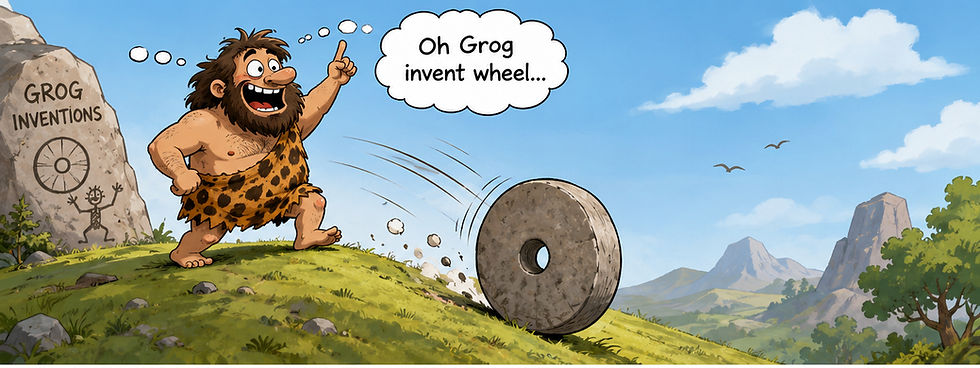
Long before strategy workshops, innovation hubs and government grants, there was Grog. Now Grog was a caveman, we think, of average height, limited vocabulary and considerable confidence. One afternoon, while trying to move a large, flat, round stone, Grog accidentally knocked it down a hill.
The stone rolled. Grog stared. The stone kept rolling. Grog’s eyes widened.
“Grog invent wheel” Grog thought proudly.
Unfortunately, the wheel then rolled directly into Grog’s neighbour, who was preparing a mammoth for dinner.

Grog rushed down the hill. “Oh no,” thought Grog. “Grog wheel hit friend.” Then Grog looked at the mammoth.
“Oh,” thought Grog. “Grog can have mammoth for dinner.”
And there, in one short prehistoric moment, we see the whole problem with technology.
The wheel can carry food, build cities, transport medicine and connect communities.
It can also flatten your neighbour and create an unexpected catering opportunity.
Was the discovery of the wheel good or bad? No. It was round.
Newton, the Apple and the Beginning of Very Complicated Mathematics
Let us now move forward several thousand years to Sir Isaac Newton.

The popular story says an apple fell on Newton’s head and, in a sudden moment of genius, he discovered gravity.
This is not quite right.
The more accurate version is less dramatic and therefore much less useful for cartoons. Newton observed an apple falling and began thinking deeply about why it fell straight down, and whether the same force might also help explain the motion of the Moon and planets.
Still, for the purposes of storytelling, “man thinks about apple from garden window” has never had quite the same marketing appeal as “apple hits genius on head.”
From that question, and Newton’s later work, came some of the most important ideas in science.
Newtonian physics helped us calculate motion, force, acceleration and gravity. These ideas helped humanity build bridges, machines, aircraft, satellites and rockets. They helped us fly across oceans, explore space and eventually send people to the Moon.
Wonderful.
But the same understanding of motion and force also helps calculate the trajectory of artillery shells, missiles and weapons.

Less wonderful.
The same physics that lets a plane fly also allows a missile to find its target. The formula does not know whether it is carrying astronauts, tourists or something that goes bang.
The math is not evil. The person applying it may require closer supervision.
Nuclear Fission: Well, That Escalated Quickly
In December 1938, Otto Hahn and Fritz Strassmann found evidence that uranium nuclei could be split after neutron bombardment. Lise Meitner and Otto Frisch then provided the theoretical explanation and helped identify the process as nuclear fission.

At first glance, this was a scientific breakthrough. It opened the door to understanding matter at a deeper level and eventually to nuclear power, medical treatments, research tools and new ways of producing large amounts of energy. But it also opened the door to nuclear weapons. This is the great tragedy and tension of powerful discovery. The same underlying science can power a city or destroy one.
Nobody needs to begin with the sentence, “Let’s invent something terrifying.”
Often the story begins with curiosity, research, theory and experiment. Then someone says, “That is interesting.” Then someone else says, “Could we use it?” Then a third person, often wearing a uniform or holding a budget, says, “How quickly?” Technology moves from discovery to application to consequence.
And somewhere along the way, society has to catch up.
So, What About AI?
This brings us back to Artificial Intelligence. AI is not the first technology with both good and bad potential.
It is just the latest, fastest and possibly most talkative.
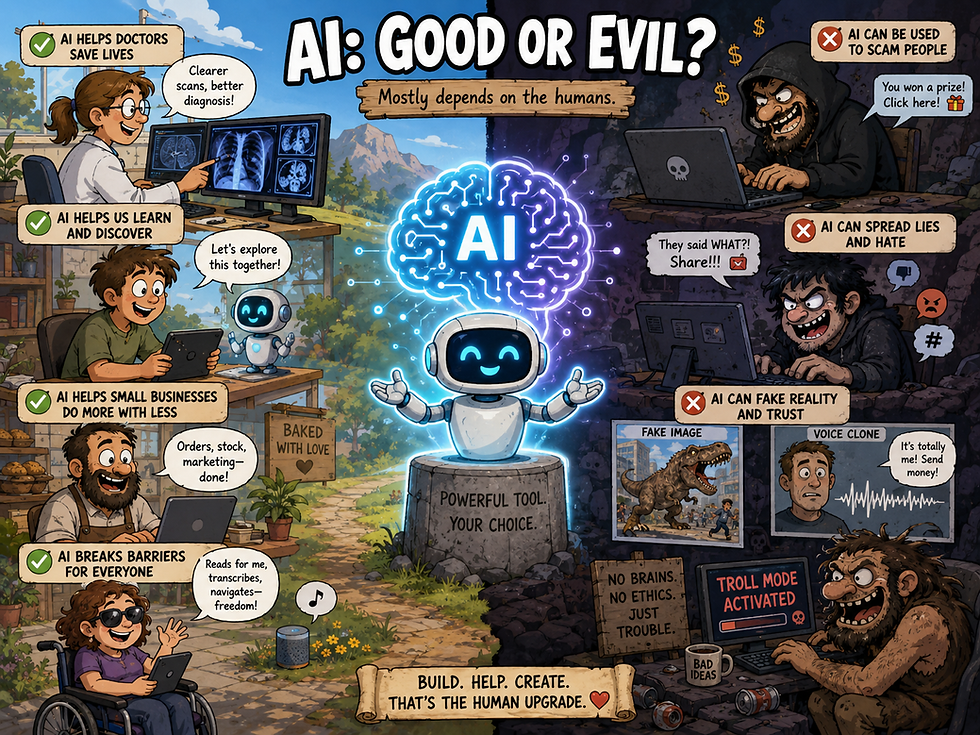
AI can help doctors identify disease earlier. It can help students learn in different ways. It can support people with disability. It can improve business productivity, summarise complex documents, detect fraud, assist scientific research, support farmers, improve logistics and help small organisations do things that once required large teams and large budgets.
That is the “good” side.
But AI can also generate fake images, clone voices, write scam emails, automate cyberattacks, spread misinformation, invade privacy, reinforce bias and produce convincing nonsense at industrial speed.
That is the “evil” side.
Or, more accurately, that is the “humans using powerful tools badly” side.
AI is not sitting in a dark cave stroking a cat and planning world domination.
At least, not yet. And if it is, it probably generated the cat in the wrong number of legs.
The problem is not that AI has suddenly introduced good and evil into technology.
The problem is that AI makes both easier to scale.
A good doctor with AI may diagnose faster.
A good teacher with AI may support more students.
A good charity with AI may reach more people.
A good business with AI may become more productive.
But a scammer with AI may scam faster.
A propagandist with AI may mislead more people.
A careless organisation with AI may make bad decisions at greater speed.
A lazy executive with AI may outsource judgement and then blame the algorithm.
That last one deserves special attention.
The Real Risk: Outsourcing Responsibility
The danger of AI is not simply that it might become too intelligent. The more immediate danger is that humans might become more stupid and too careless.
We may accept AI outputs without checking them.
We may automate decisions that should involve human judgement.
We may use AI to cut costs without considering people.
We may collect more data than we need.
We may replace thinking with prompting.
We may confuse speed with wisdom.
This is where the good-versus-evil debate becomes too simple. The real question is not “Is AI good or evil?”
The real questions are:
Who is using it?
For what purpose?
With what safeguards?
With what accountability?
And who gets hurt if it goes wrong?
The evil is in the people and not the technology.
That is where governance matters. Not because governance is exciting. It is not. Nobody has ever shouted, “Gather round, children, and hear the thrilling tale of the risk management framework.”
Governance is what stops powerful tools from becoming dangerous toys.
Less Panic, More Responsibility.
There are people who want to ban AI, fear AI or pretend it will go away. It will not! There are others who want to rush into AI without rules, ethics or basic common sense. That is also unwise. The sensible path sits somewhere between “burn the machines” and “let the chatbot run the company.”

Key Rules for AI – Like Any Other Technology
Governance is needed to:
Use AI carefully, openly and responsibly.
Understand what it is good at and what it is not good at.
Protect privacy, security and intellectual property.
Manage bias and misinformation.
Support workers whose jobs will change.
Teach people how to use AI well.
Stop fools from making mistakes.
We need boards, executives, governments, educators and communities to understand that AI is not magic. It is a tool. A powerful one, but still a tool.
And like every powerful tool, it needs governance: rules, skill and judgement.
Humans in the Middle Define Good or Evil
The wheel did not decide to hit Grog’s neighbour.
The apple did not decide to create missile guidance.
The atom did not decide to become a bomb.
AI does not decide, by itself, to be good or evil.
Humans decide.
Humans design the systems.
Humans set the incentives.
Humans write the laws.
Humans ignore the warnings.
Humans chase the profits.
Humans also do enormous good with AI that rarely makes the headlines: curing disease, educating children, building communities, solving problems and creating extraordinary things. If we restrict or ban the technology will good outcomes get lost?
That is why AI is not really a story about machines or software or LLMs.
AI risk should be managed according to use case, not by panic or blanket bans
Low-risk AI use should be encouraged. High-risk AI use should require stronger oversight, testing, transparency and accountability. The same AI tool used to summarise a meeting is not the same risk as AI used to approve a loan, diagnose a patient, manage infrastructure or influence voters.
Australia has proposed mandatory guardrails for AI in high-risk settings, the OECD AI Principles focus on trustworthy AI that respects human rights and democratic values, NIST’s AI Risk Management Framework is built around governing, mapping, measuring and managing AI risk, and ISO/IEC 42001 provides an AI management-system standard for organisations.
So perhaps the question is not: “Is AI good or evil?”
The Better Question
“When we give humans a powerful new tool, will we be more like the doctor, the teacher and the scientist — or more like Grog eyeing off the mammoth?”
Because AI may be artificial. But the intelligence, responsibility and morality still need to be real.
The answer is not to fear the tool but rather to learn how to use it. The answer is to make sure the humans using it are competent, accountable and occasionally supervised by someone with common sense.
There have been a lot of loud voices asking to restrict, or even ban, AI technology. There has been a lot of media noise about the negatives but little about the positives.
The recent headlines do not show AI waking up evil. They show people using AI to make bad decisions, and with bad behaviour; faster, cheaper, more believable and harder to detect. And some governments and policy makers seeing AI more as a weapon and less as a beneficial tool we can all use.
Recent headlines about human misuse of AI
13 June 2026 — "The Anthropic Foreign Ban":
Concern: The Trump administration issued an emergency directive to Anthropic requiring the suspension of their newest AI models (Fable 5 and Mythos 5) for all foreign nationals, whether located inside or outside the United States.
The Reason: The U.S. government cited national security concerns, specifically noting that a potential vulnerability or "jailbreak" had been identified that could bypass the system's safety guardrails.
The Compliance: Because foreign national employees were affected and the directive was difficult to partition, Anthropic opted to completely suspend global access to these models.
June 2026 — "The Anomaly: Broader US Federal Policy":
Concern: In a related move, the Trump administration issued National Security Presidential Memorandum 11, directing national security agencies to prioritize AI adoption, and threatened to terminate federal contracts with AI companies if their safety guardrails consistently restricted government and military access.
14 Jun 2026 — “AI Supercharges Deepfake Nudes—Unleashing a New Form of Bullying Among Kids”:
Concern: AI-generated intimate deepfakes being used for bullying, harassment and exploitation, especially among school-aged children.
12 Jun 2026 — “Google targets AI-powered phishing in New York lawsuit”:
Concern: AI tools allegedly being used to help criminals create convincing phishing sites and steal personal and financial data. Reuters reported Google said it detected more than 1.5 million URLs linked to the alleged phishing kit between November and April.
11 Jun 2026 — “9 out of 10 people can no longer distinguish real from AI-generated content”:
Concern: AI-generated messages, voices, photos, reviews and identities are making online fraud harder to detect.
9 Jun 2026 — “Bank of England warns of AI scams as deepfakes of Farage-Bailey fight spread”:
Concern: AI deepfake videos were used in apparent investment-scam material, with the Bank of England warning that fake adverts impersonating central banks are rising.
4 Jun 2026 — “Reddit Ads Impersonate BBC and The Guardian to Push Fake AI Investment Schemes”:
Concern: Sponsored Reddit ads allegedly impersonated trusted media brands and used AI-themed investment stories, fake endorsements and deepfake-style media to lure victims.
2 Jun 2026 — “Report: Election disinformation increasing with AI”:
Concern: AI-enabled disinformation, phishing, impersonation and fake domains are being flagged as major election-interference risks ahead of the 2026 US midterms.
27 May 2026 — “Deepfakes Are Becoming a Decision-Security Problem”:
Concern: Deepfakes are no longer just fake videos; they can corrupt trusted workflows in government, elections, emergency response, critical infrastructure and corporate decision-making.
19 May 2026 — “AI-related data breaches surging, Verizon report says”:
Concern: Hackers are using AI to identify software vulnerabilities faster, shortening the defensive response window from months to hours in some cases.
30 Apr 2026 — “Australian banks warned frontier AI could create larger, faster cyber attacks”:
Concern: APRA warned that Australia’s banks were not keeping pace with AI-related security risks and that frontier AI could increase the probability, speed and scale of cyberattacks.
24 Apr 2026 — “Europe’s markets watchdog warns cyber threats are growing as AI speeds up risks”:
Concern: Europe’s securities regulator warned that AI could increase the speed of cyberattacks against the financial sector.
28 Mar 2026 — “AI deepfakes blur reality in 2026 US midterm campaigns”:
Concern: Political AI deepfakes are entering campaign advertising in a lightly regulated environment, with experts warning voters may be confused or deceived.



Comments