
Losing Can Make You a Winner If You Learn the Right Lessons

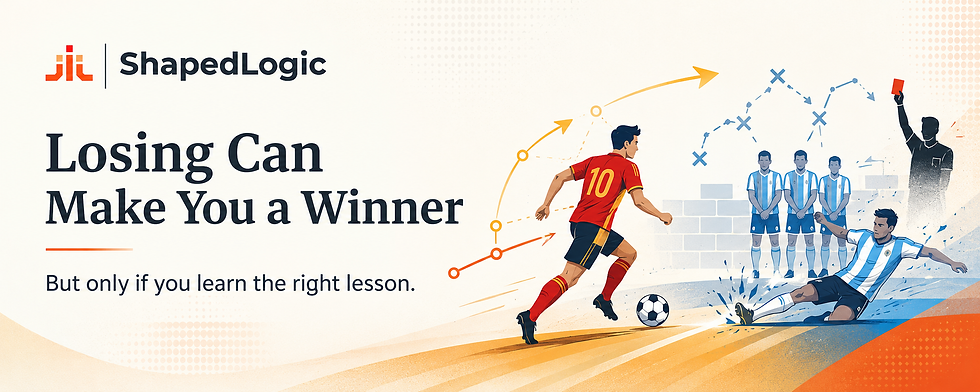
Three years ago, I wrote about the need to learn from your mistakes, not just in life or sport, but also in business. Repeating the same mistakes will generally lead to the same result. Many people in business, sport and life celebrate their wins and mourn their losses.. Not just in life or sport but also in business. Repeating the same mistakes will, generally, lead to the same result. Many people in business, sport and life celebrate their wins and mourn their losses.
We grow up hearing that winners are grinners, that second place is the first loser and that success is the best proof that we were right.
But winning can sometimes teach us very little.
A strong result may conceal a weak strategy, poor behaviour, excessive risk or simple good fortune. A loss, by contrast, can expose uncomfortable truths. That does not mean losing automatically makes us wiser.
A defeat is only an opportunity to learn. Whether we use that opportunity is another matter entirely.
The World Cup final revealed two very different approaches
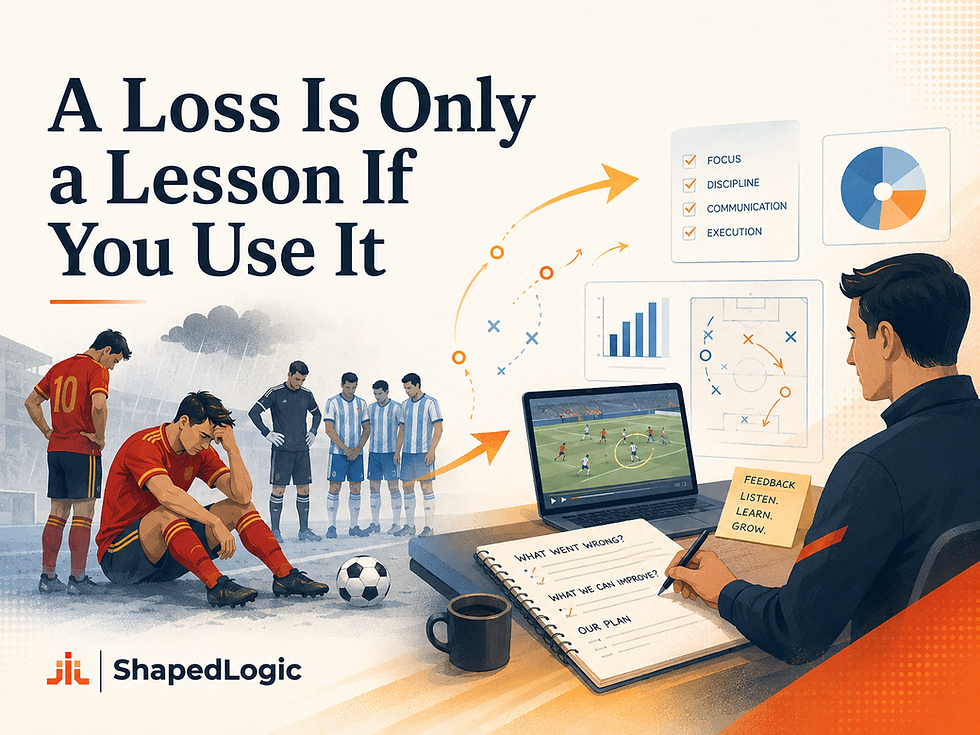
The 2026 FIFA World Cup final between Spain and Argentina was an extraordinary example.
Spain won 1–0 after extra time, with substitute Ferran Torres scoring in the 106th minute. Spain dominated possession and attacking opportunities, while Argentina concentrated on containing its opponent. Argentina did not record its first attempt on goal until the 115th minute.
There is nothing inherently wrong with defensive football. A disciplined defensive strategy can be intelligent, courageous and effective. Sometimes the correct response to a stronger attacking opponent is to absorb pressure and counterattack.
The problem occurs when defending becomes the entire purpose of the game.
Argentina appeared increasingly focused on preventing Spain from winning rather than developing a realistic plan of its own. Even after Spain’s dominance had become obvious, Argentina continued to reduce its attacking options. Even after being reduced to ten men, Argentina remained overwhelmingly focused on containing Spain rather than creating an attacking response.
That strategy nearly forced a penalty shootout. It might even have succeeded.
But “nearly” is often where the most useful lessons are found.
Spain remained patient, trusted its style and continued creating opportunities. Argentina waited for the game to come to it.
Eventually it did, but not in the way Argentina wanted.
When aggression becomes a liability

Argentina’s tactical caution was accompanied by a loss of discipline.
Enzo Fernández was booked for dissent and then dismissed after receiving a second yellow card. Other confrontations occurred during the match, and the final whistle was followed by pushing and angry exchanges involving several players.
That raises an important distinction.
Playing physically is part of football. Competing intensely is not unethical. Nor should a team politely surrender simply because an opponent is playing better.
But aggression that produces penalties and cards, reduces the number of players available and distracts people from the objective is not effective. It is a strategic failure.
The same applies in business.
An organisation can negotiate firmly, compete aggressively and defend its market position. But attacking competitors, intimidating employees, misleading customers, bending regulations or blaming everyone else eventually consumes attention and destroys trust.
Rules are not merely obstacles placed in the way of winning. They define the competition in which everyone has agreed to participate. If your strategy depends on repeatedly crossing those boundaries, the strategy itself is defective.
Did Argentina learn from losing?

It is too early to know what Argentina will ultimately learn from the final.
The immediate behaviour of some players suggested that anger was initially stronger than reflection. That may have cost the team its first opportunity to learn: the opportunity to accept the result, acknowledge the winner and honestly examine what happened.
There were also better moments. Lionel Messi and Spain’s young star Lamine Yamal embraced after the match, an acknowledgement that competition and respect can coexist.
Argentina now has several difficult questions to consider:
Did the team play to win, or merely try not to lose?
Why was there no effective attacking alternative when the original strategy was not working?
Did frustration and dissent make an already difficult task harder?
Were players encouraged to remain composed under pressure?
Did the team’s behaviour enhance or diminish the reputation built through years of success?
The answers will determine whether this was simply a lost final or the beginning of a stronger future team. A loss provides information. Learning occurs only when that information changes future behaviour.
Not every failure deserves to be celebrated

The modern business world often tells us to “fail fast” and “fail often”.
Use a blameless review, but not an accountability-free one.
Harvard Business School professor Amy Edmondson distinguishes between intelligent failures, basic failures and complex failures. Intelligent failures occur when a thoughtful, limited experiment in genuinely new territory produces an unexpected result. Basic failures are more likely to involve preventable errors, carelessness or departure from established knowledge.
Testing a new product with a small group of customers and discovering that they do not want it may be an intelligent failure.
Launching the same product nationally after ignoring negative testing is not.
Trying a new football formation against a strong opponent may produce valuable information.
Losing a player because repeated dissent and reckless challenges lead to a red card is not an intelligent experiment. It is a preventable loss of capability.
We should encourage experimentation, but we should not romanticise negligence.
The objective is not to celebrate every failure. It is to create inexpensive, ethical and recoverable experiments while preventing failures whose causes are already understood.
Failure is data, not identity
One reason people struggle to learn from losing is that they treat the result as a judgement about who they are.
“I failed” becomes “I am a failure.”
Once that happens, the natural response is self-protection. We find excuses, blame circumstances, attack the winner or reinterpret the result until it no longer threatens our self-image.
Recent research indicates that people often learn less from failure than from success because negative feedback threatens the ego and causes them to disengage from the information it contains.
A better approach is to separate identity from performance.
The result does not tell us that we are worthless. It tells us that a particular combination of assumptions, decisions and actions did not produce the intended outcome.
That is data.
Data can be examined.
Use a blameless review, but not an accountability-free one
Modern technology organisations frequently conduct post-incident reviews after outages and operational failures.
Google’s Site Reliability Engineering guidance recommends a blameless approach that assumes people acted with good intentions and made decisions using the information available to them. The purpose is to understand how the system allowed the incident to occur and how it can be made more resilient.
Blameless does not mean consequence-free.
It means beginning with curiosity rather than accusation.
A useful review asks:
What were we trying to achieve?
What did we expect to happen?
What actually happened?
Which assumptions proved incorrect?
What warning signs did we miss or dismiss?
Where did our behaviour make the situation worse?
What will we change before the next attempt?
Who will be responsible for making that change?
The final question is critical.
A lesson without an owner, deadline or changed process is merely an observation.
Technology gives us more evidence but not necessarily more wisdom
Professional teams can now analyse every pass, movement, decision and physical response. Businesses have customer analytics, sales recordings, sentiment analysis, artificial intelligence, digital simulations and enormous quantities of operational data.
We have never had more ways to examine a loss.
Yet data cannot make an organisation honest.
Artificial intelligence may identify the moment a strategy stopped working. It cannot force a leader to admit that the strategy was wrong.
A dashboard may show that customers are leaving. It cannot prevent executives from blaming the customers.
Video may reveal repeated aggressive conduct. It cannot make a team decide that discipline matters more than intimidation.
Technology can show us what happened. Culture determines whether we are willing to see it.
Losing well is a competitive capability
When I was a trainee sales representative, I was told that it could take ten “nos” to obtain one “yes”. The lesson was not that rejection should be enjoyed. It was that each unsuccessful conversation could improve the next one.
Was I speaking to the right person?
Had I understood the customer’s problem?
Was I explaining benefits or merely listing features?
Did the competitor offer something better?
Had I listened properly?
The most valuable response after losing a sale was often to congratulate the successful competitor or thank the customer and ask one straightforward question:
“What could I have done better?”
That question preserves the relationship and opens the door to information that excuses will never provide. It also demonstrates confidence.
People remember those who lose professionally.
Winning is more than the final score

Spain won the match by scoring the only goal, but its broader achievement came from patience, discipline and confidence in a clearly defined style.
But its broader lesson was about patience, identity and continuing to play the game it believed could succeed.
Argentina’s lesson is more complicated.
It did not lose simply because it defended. It lost after its defensive strategy failed to evolve, its attacking ambition almost disappeared and indiscipline reduced its options further.
Whether Argentina also loses the opportunity to learn will depend on what happens next after the anger fades, the replays are examined and the difficult conversations begin. That is equally true in business and life.
Losing can make you more observant, more disciplined, more resilient and ultimately more successful.
But only when you are prepared to examine both your strategy and your conduct.
The important question is not simply: “Did we win?”
It is: “Did this experience make us better without making us worse?”
A loss can help make you a winner.
But first, you must be prepared to lose the excuses.
Author: John Debrincat, Principal Consultant, ShapedLogic.
For further information or questions please contact us.


Comments